Rewind Portfolio

Rewind your portfolio. Live it forward.

Take your portfolio back in time. Discover what retirement will be like today.

Rewind your portfolio. Live it forward.

Take the portfolio you have today and go back. To the 2008 financial crisis, the COVID 2020 epidemic, the 2022 inflation shock, the 2025 tariff shock. To every crisis of the last twenty years. Then live it forward with your current portfolio, your balance, your securities, your retirement withdrawal strategy, month by month, through the headlines, the politics, the gas prices, the layoffs, the rallies and the panics, with your balance on screen and your withdrawal landing every month. You find out how your plan feels before you are living it.

The first film: one plan, rewound to 2007, through the crisis. Eleven minutes. Free.

The question you keep asking

What will retirement be like? How will it feel?

Everyone going into retirement asks it, and no chart answers it. Rewind Portfolio gives you that insight. It gives you the answer to “should I retire?” And it gives you the confidence to make that commitment.

Where you can go

The seven financial crises of the last twenty years, and soon your own dates. Pick the one you remember, or the one you fear.

Coming soon

The dot-com crash, 2000–03

March 2000 to December 2003

You retire on March 1, 2000, with the Nasdaq nearly doubled in a year and the economy in the longest expansion on record. On March 10 the Nasdaq peaks; within a year it has lost more than half its value, and companies worth billions are gone. In 2001 the economy slips into recession, and Fed Chairman Alan Greenspan cuts rates eleven times. On September 11 terrorists attack New York and Washington, and the stock market closes for four days. Enron and then WorldCom collapse in accounting scandals, and in March 2003 President Bush sends troops into Iraq.

More about this period →


The Lehman Brothers headquarters at 745 Seventh Avenue, its screens lit at night, September 2008
Coming soon

The 2008 financial crisis

September 2007 to October 2013

You retire on September 1, 2007, as the housing bubble bursts. Within a year, President Bush and Fed Chairman Ben Bernanke face the worst financial crisis since the Depression: Bear Stearns is sold in a weekend, then Lehman Brothers goes bankrupt, Congress passes a $700 billion bailout, and rates are cut to almost zero. President Obama takes office in the middle of it, unemployment reaches 10%, and Europe's debt crisis and a downgrade of America's credit rating are still to come.

More about this period →
Coming soon

The debt ceiling and Europe, 2011–12

May 2011 to September 2012

You retire on May 1, 2011, two years after the last crash hit bottom, and that night President Obama announces that Osama bin Laden has been killed. By summer, President Obama and Speaker John Boehner are fighting over the debt ceiling to the last day. S&P cuts America's credit rating for the first time, and the market has its worst day since 2008. Greece and Italy push Europe into a debt crisis, gas is near $4, and the Fed promises to keep rates at almost zero. In May 2012 Greeks line up to empty their bank accounts, and in July European Central Bank President Mario Draghi says he will do whatever it takes to save the euro.

More about this period →
Coming soon

China and oil, 2015–16

August 2015 to July 2016

You retire on August 1, 2015, six years into a rising market. Ten days later China devalues its currency, and on August 24 the Dow drops more than 1,000 points in its first minutes of trading. Oil keeps falling, to $26 a barrel in February, and in December Fed Chair Janet Yellen raises rates for the first time in almost ten years. The new year opens with China halting its own stock market twice in one week, and in June Britain votes to leave the European Union.

More about this period →
Coming soon

The late-2018 sell-off

October 2018 to April 2019

You retire on October 1, 2018, with the market near a record high, and that Friday unemployment falls to 3.7%, the lowest in almost 50 years. Two days after you retire, Fed Chairman Jerome Powell says rates are "a long way" from neutral, and October becomes the market's worst month in seven years. President Trump threatens more tariffs on China, oil falls by more than 40%, and in December the Fed raises rates again. Three days before Christmas, the government shuts down.

More about this period →
The CDC's illustration of the coronavirus: a grey sphere covered in red spikes
Coming soon

The 2020 COVID pandemic

February 2020 to August 2020

You retire on February 1, 2020, with the market near a record and unemployment the lowest in 50 years, while a new virus spreads in China. By March it's everywhere. The market falls faster than it ever has from a record, trading is halted four times in two weeks, and Fed Chairman Jerome Powell cuts rates to zero on a Sunday. Offices, schools and stores close, 20 million jobs are lost in April, and Congress passes a $2.2 trillion rescue.

More about this period →
A gloved hand holds up a vial of COVID-19 vaccine, Walter Reed National Military Medical Center, December 14, 2020
Coming soon

The COVID Winter

September 2020 to February 2021

You retire on September 1, 2020, with the market back at a record six months after its fastest fall ever, and millions still out of work. Within a week, the Nasdaq falls 10% in three trading days. Cases climb through the fall, President Trump is taken to the hospital with the virus a month before the election, and Joe Biden wins it. On November 9, Pfizer says its vaccine works, and the first shots are given on December 14. In January, more than 4,000 Americans die of COVID in a single day, a mob storms the Capitol, and President Biden takes office. By late February, the dead pass 500,000.

More about this period →
Coming soon

The inflation shock, 2021–23

March 2021 to February 2023

You retire on March 1, 2021, a year after COVID shut the country, with vaccines going into arms and the market near a record. On March 11 President Biden signs a $1.9 trillion relief bill, and by May prices are rising faster than at any time since 2008; Fed Chairman Jerome Powell calls it transitory. In February 2022 Russia invades Ukraine, by June gas is over $5 a gallon, and inflation passes 9%, the highest in more than 40 years. The Fed raises rates faster than at any time since the early 1980s, and stocks and bonds fall together.

More about this period →
Coming soon

The 2023 banking crisis

March 2023 to December 2023

You retire on March 1, 2023, a year into the fastest rate rises in four decades, with inflation still above 6%. On March 10 Silicon Valley Bank fails in two days, the biggest bank failure since 2008; two days later Signature Bank fails, and Treasury Secretary Janet Yellen and the Fed guarantee every deposit at both. UBS takes over Credit Suisse, and in May First Republic is seized and sold to JPMorgan Chase. In October the ten-year Treasury touches 5%, a rate last seen in 2007, and in December Fed Chairman Jerome Powell says rate cuts are being discussed.

More about this period →
Coming soon

The 2025 tariff shock

February to June 2025

You retire on February 1, 2025, twelve days after President Trump's second inauguration, and that day he orders tariffs on Canada, Mexico and China. The market sets a record on February 19, then slides. On April 2 the President announces tariffs on almost every country, and the market has its worst two days since COVID. China answers, tariffs between the two pass 100%, and for once Treasury bonds and the dollar fall along with stocks.

More about this period →
Coming soon

Custom period

Your dates

Pick your own dates: any month from January 2008 on as the day you retire, and any later month as the end. Your portfolio lives every month in between, with the people, the headlines and the moves that touched your money, and your withdrawal deposited into your checking account at the end of each one.

More about this period →

What you get that a historical financial graph, report, or backtest cannot give you

Live it again, the way it happened.

Not a chart of 2008. The world as it unfolded, one month at a time. The front page the morning Lehman went. Gas at four dollars. The grocery bill creeping up. The unemployment number climbing. The bull market you rode in on, the highs that felt permanent, the bear market, the lows, the fear that it might not come back, and the day it did. And what was happening in the world on the exact day your portfolio hit bottom.

Know whether you can hold, not just whether it holds.

Every retirement calculator ends with the same word: survives. None of them tell you what the seventy-four months in between feel like, or whether you would have sold at month nineteen. That is the only question that matters, and it is the one they skip.

Feel the worst year without paying for it.

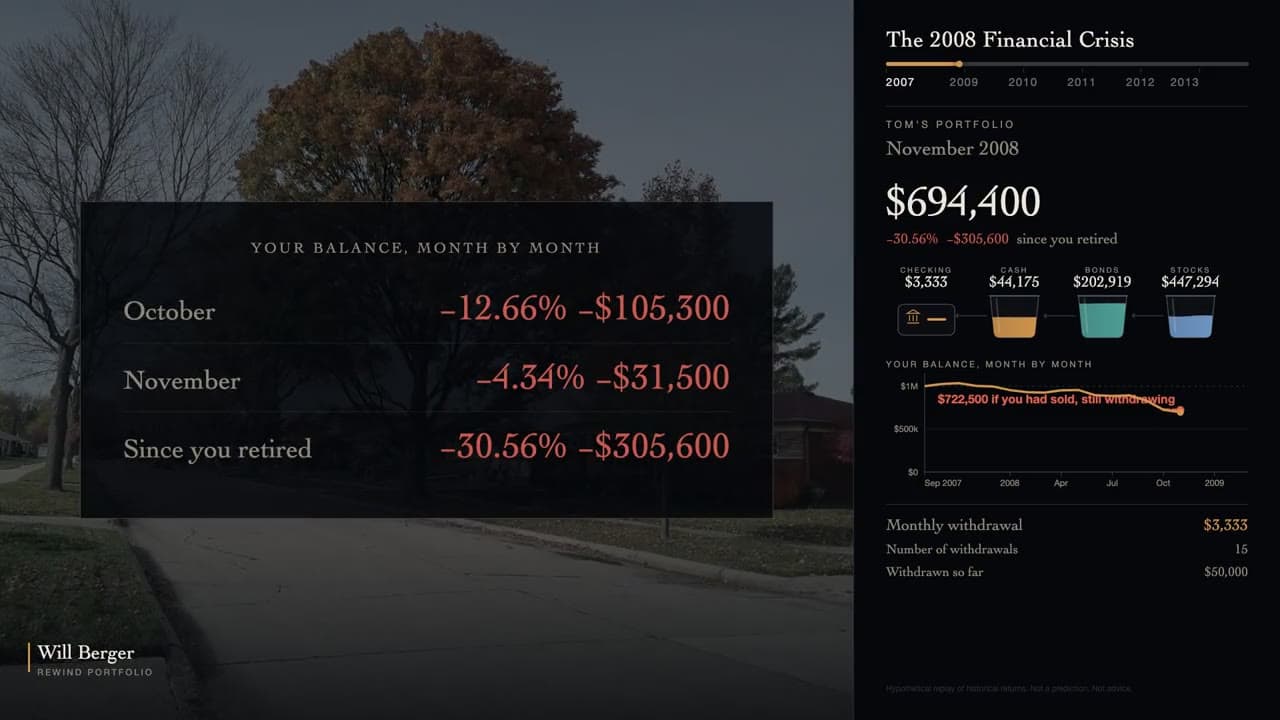
The dread of October 2008. The relief of the spring rally and the sick feeling when it gave it all back. The bottom, when everyone you knew was selling. The elation of the highs, years later, that you almost didn't stay for. There are two ways to learn what that does to you. One is to have it happen. The other is this.

Your balance, your withdrawal, your dates.

Enter what you will retire with, what you will take out each month, and the strategy you are using. Choose the years you remember. The film is about your account, not a hypothetical one.

Every move your plan makes, said out loud.

When cash is refilled from bonds, you hear it. When the plan does nothing for a year, you hear that too. A plan you understand is a plan you can hold.

Bring your advisor with you.

Take your own advisor back in time too. They walk through your portfolio month by month and tell you what they would do: when they would rebalance, when they would refill cash, when they would do nothing and why. You find out today how your advisor will get you through the next crisis, before it happens.

Decide together.

A film you and your spouse watch on the couch beats a spreadsheet one of you reads. The second viewing is the one that settles it.

We made the first one. A million dollars, $3,333 a month, retired September 1, 2007. Eleven minutes. Sign up and watch it.

Your plan survived 2008. Would you have?

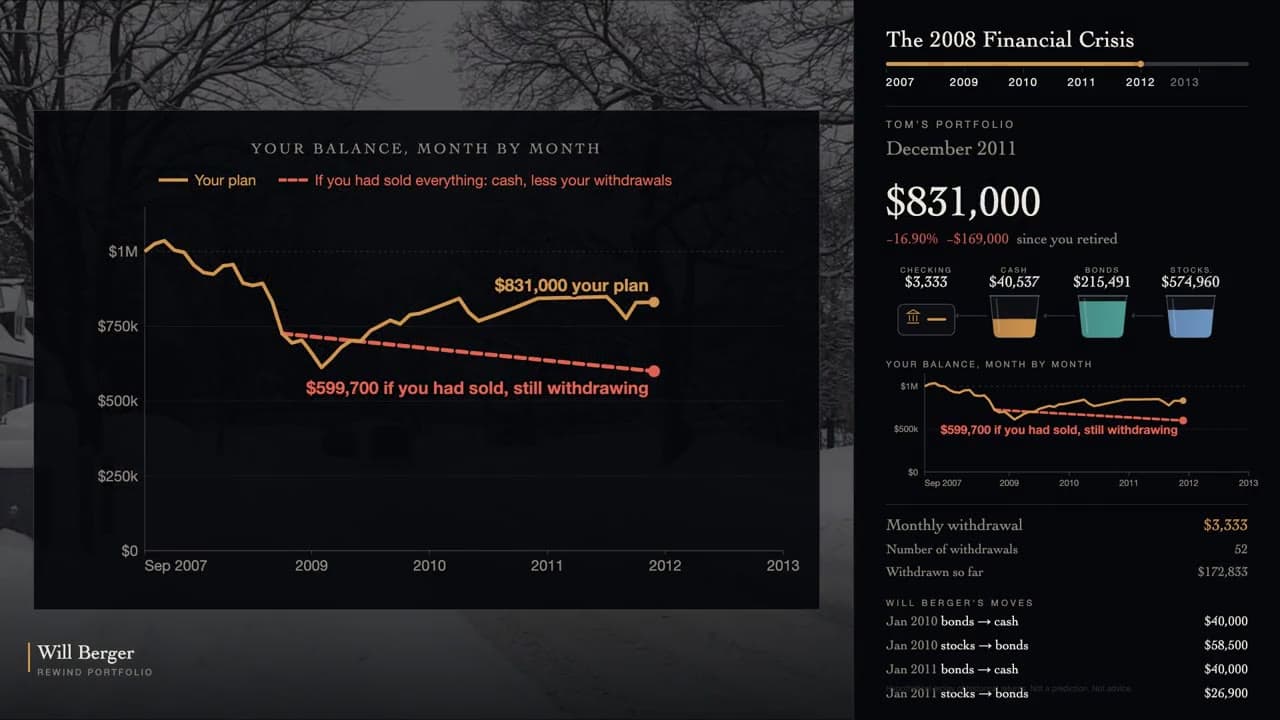
Every backtest of 2008 ends the same way: the balance comes back. What the backtest assumes, quietly, is that you held. That you watched a million dollars fall by a third, took your withdrawal on the thirtieth, and did nothing. Then did nothing again for four years while it climbed back so slowly you could not feel it.

Most people did not do nothing. They sold somewhere near the bottom, and then waited for a signal to get back in. There wasn't one.

Rewind Portfolio does not tell you which kind of person you are. It puts you in the months and lets you find out, while it is still cheap to know.

Four moments you will not forget

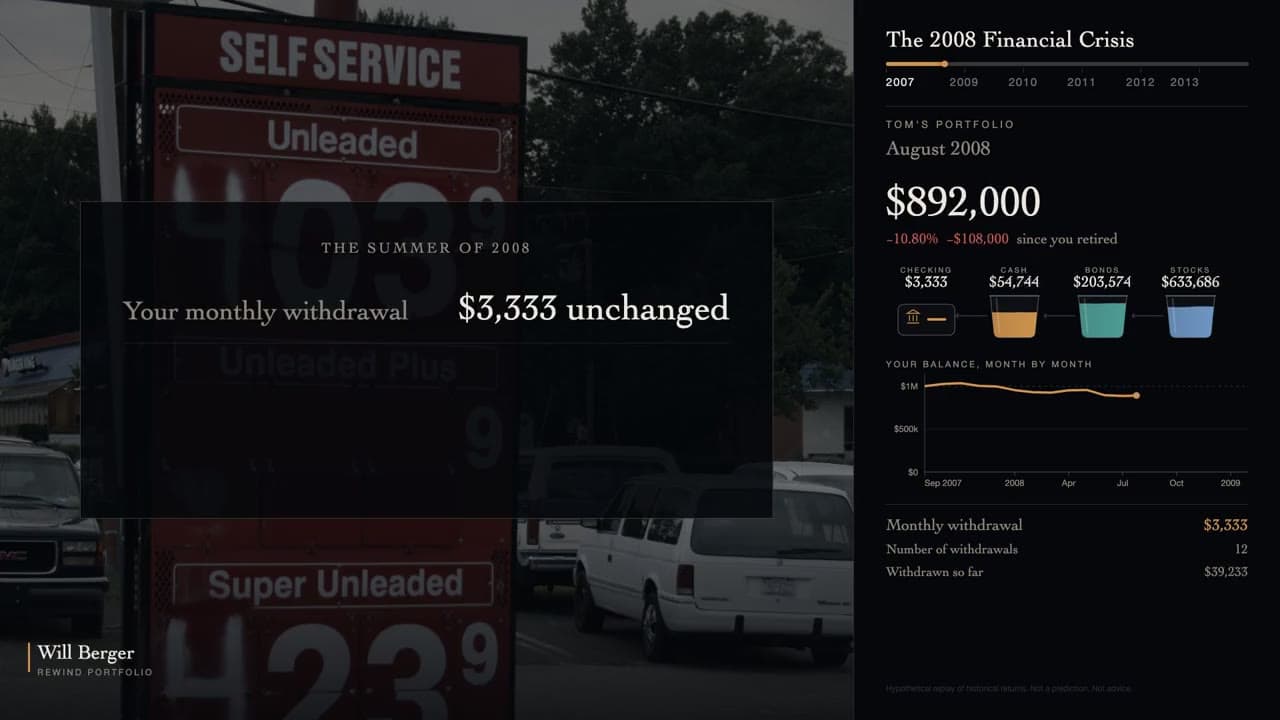
The summer of 2008

The summer of 2008

Gas at four dollars, the balance already slipping, and your withdrawal landing unchanged.

The bottom

The bottom

The balance is as low as it gets. The advisor tells you what he is doing, and it is not what your stomach wants.

The climb you can't feel

The climb you can't feel

Two years of gains that never once felt like gains. This is the part nobody shows you, and it is where people actually quit.

The crossing

The crossing

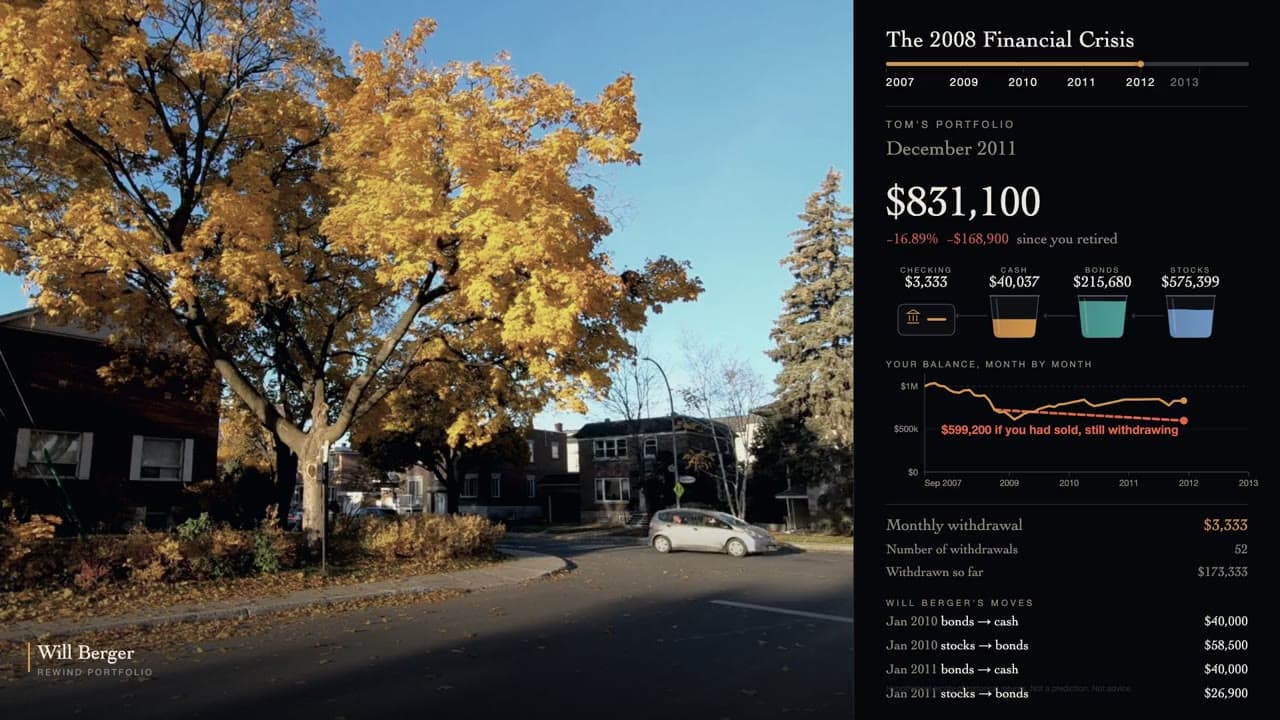
The month you got back to where you started, seventy-four withdrawals later.

The advisor option

Find out how your advisor handles a crisis before you are in one.

You can take your advisor back in time with you. They sit in the advisor's seat in your film, with your portfolio, and walk you through it: what they would do in the month Lehman fell, whether they would sell in March 2009, how they would keep your withdrawal landing when stocks are down forty percent, what they would say to you on the day you wanted out.

Every move, said out loud, in their voice, with no hindsight. Not a promise in a brochure. Their actual plan for your actual money, tested against a crisis that already happened.

Most people find out how their advisor handles a crisis during one. This is the other way.

Already an advisor? This is how your clients get to hear you act. See how advisors use Rewind →

How it works

1

Pack your portfolio.

Balance, monthly withdrawal, strategy. What you actually have.

2

Pick a time.

A crisis you lived through, or one you fear. The years you remember.

3

Live it forward.

Month by month, the world and your account, two voices, no hindsight. Not “does it survive.” Whether you would have.

See how it works →

Know someone who is about to retire?

The people this film is for do not go looking for it. Someone sends it to them. If your dad, your sister, or the friend who keeps saying “I think I can do it” needs to see this, send them this page. It is free.

Text itEmail it

Financial advisors

Your clients want to know how you handle a crisis. Show them, before one.

Every prospect who signs up here has one question they will not ask you out loud: what will you actually do when it falls. Rewind puts you in the advisor's seat of their film, with their portfolio, and lets them hear you manage it through 2008. The one who thought he could do it himself hears what that would have cost. The one who is with you already hears why he should stay.

How advisors use the film →

Rewind Portfolio is made by Quant Makers LLC. The founder retired in 2026 after living his own plan through seven crises, one month every morning. Read the story →